Best Music Promotion Tools for Independent Artists in 2026
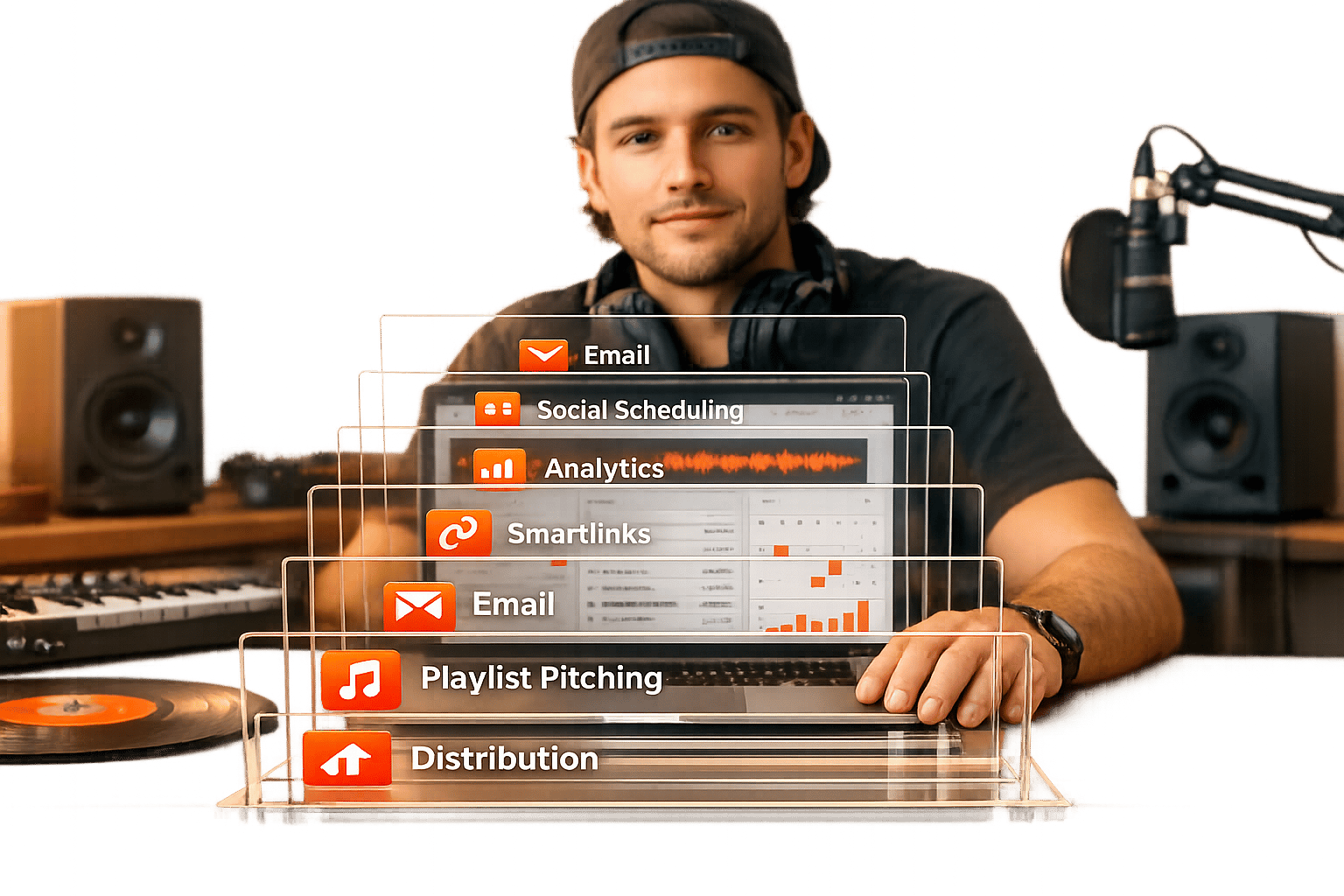
Promoting your music in 2026 is all about using the right tools to reach your audience and keep them engaged. Independent artists now have access to advanced platforms for distribution, playlist pitching, fan communication, and analytics – tools that were once exclusive to major labels. Here’s what you need to know:
- Distribution: Services like DistroKid and CD Baby make it easy to get your music on streaming platforms.
- Playlist Promotion: Spotify for Artists allows direct pitching to editorial playlists, while tools like Promoly connect you with tastemakers and DJs.
- Social Media Management: Platforms like Buffer and Later help you schedule posts across TikTok, Instagram, and YouTube.
- Fan Communication: Email tools like MailerLite offer a direct way to connect with fans, achieving better engagement than social media.
- Analytics: Free tools from Spotify and Apple Music provide real-time insights, while services like Chartmetric consolidate data across multiple platforms.
The key takeaway? Focus on "owned momentum" – building direct, lasting relationships with your fans through email, SMS, and smartlinks, rather than relying on unpredictable social media algorithms.
Below, we’ll explore how these tools work and how to integrate them into your strategy for maximum impact.
Top Tools for Indie Artists 2026: Distribution, Direct 2 Fan, Marketing+
sbb-itb-888513b
Key Categories of Music Promotion Tools
Promoting music in 2026 requires a set of tools tailored to specific tasks, each playing a crucial role in your strategy. Knowing how these tools fit into your workflow helps you avoid overspending and keeps things streamlined – something that can be a challenge for independent artists. Here’s a breakdown of the main categories and how they contribute to your promotional efforts.
Distribution and Profile Management
Before you can start promoting, your music needs to be available on the right platforms with all the correct details. Digital distributors like DistroKid (starting at $24.99/year for unlimited uploads) and CD Baby ($9.95 per single, one-time fee) handle the heavy lifting of getting your tracks onto streaming services. Once your music is live, it’s essential to claim your profiles on Spotify for Artists, Apple Music for Artists, and YouTube Studio – all free tools. These platforms let you manage your visual branding, pitch unreleased tracks to editorial teams, and access exclusive data about your listeners that third-party tools can’t provide.
"Most music promotion tools are built for labels and sold to independent artists. That’s the core problem nobody wants to talk about." – Ulises, NotNoise Team
Playlist and Tastemaker Promotion
Playlists remain one of the best ways to get your music in front of new audiences. Through Spotify for Artists, you can pitch unreleased tracks directly to Spotify’s editorial team – just make sure to do it at least 28 days before release (7 days is the minimum). Beyond editorial playlists, there are platforms that connect you with independent curators, bloggers, and even radio hosts. Keep in mind that having clean audio files, accurate metadata, and a well-maintained artist profile is critical – sloppy submissions are a quick way to get overlooked.
Social Media and Content Scheduling
Social platforms like TikTok, Instagram, YouTube, and Threads are where music discovery happens most often today. However, keeping up with real-time posting across multiple platforms can be exhausting. Tools like Buffer (free for up to 3 channels; $20/month for the Essentials plan) help you plan and schedule content in advance, ensuring your profiles stay active without overwhelming you. Consistency is key – the algorithm favors regular posting, and gaps in activity can cause you to lose momentum.
Email and Direct-to-Fan Communication
Social media reach is never guaranteed – it’s borrowed space. Email, on the other hand, gives you a direct connection to your audience. While Instagram posts typically reach around 12% of your followers, email open rates exceed 50%. Building an email or SMS list early – even with just 100 engaged fans – gives you a reliable way to communicate that isn’t affected by algorithms. Tools like MailerLite (free for up to 1,000 subscribers) make it easy to start building this critical fan base.
Analytics and Tracking
Effective promotion depends on understanding your audience, and that starts with data. Free tools like Spotify for Artists and Apple Music for Artists provide insights into who’s listening and where they’re located. For a more comprehensive view across multiple platforms, services like Chartmetric (starting at $9.99/month) consolidate data from Spotify, Apple Music, YouTube, TikTok, and more. To get the most out of these tools, make it a habit to review your analytics weekly, not just after a release, so you can identify trends early and refine your strategy.
Playlist, DJ, and Tastemaker Promotion Tools
Getting your music in front of curators and DJs isn’t just about having their contact details – it’s about making sure your pitch gets noticed and tracked effectively.
Promoly
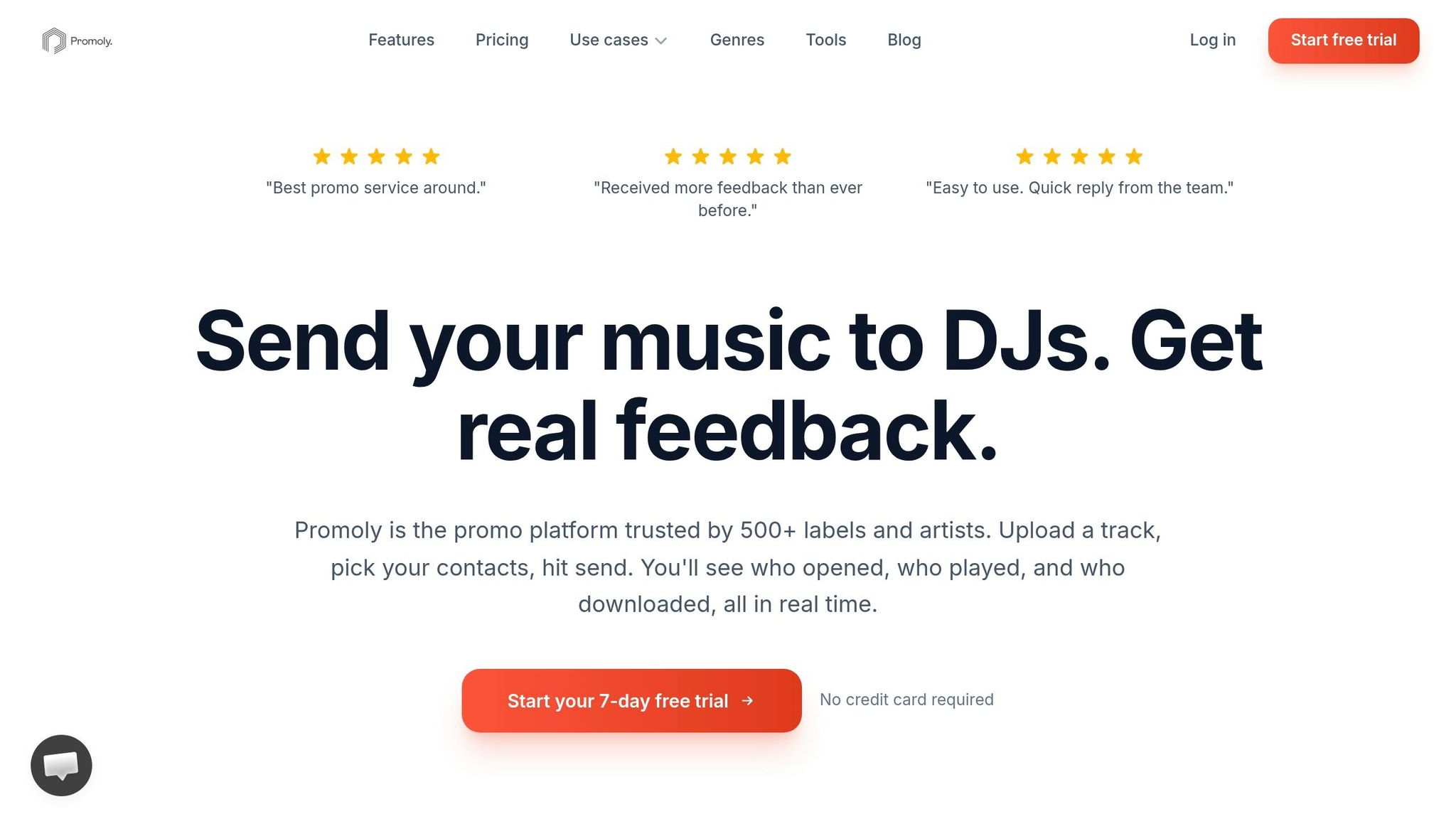
Promoly simplifies this process. This promo platform helps you send music directly to DJs, playlist curators, and tastemakers while tracking every interaction – whether it’s an open, play, or download – in real time. Plus, its Tastemaker Network gives you access to over 1,300 DJs and curators who have opted in to receive new music, saving you from the hassle of building a cold contact list from scratch.
Setting up a campaign is quick and easy – just paste your UPC, and Promoly automatically fills in metadata and streaming links. From there, its AI assists with crafting your promo copy and recommending the most relevant contacts based on your genre and release type.
"It takes about one minute to start and send a campaign but still has everything you need." – TJ Flanders, Never Say Die Records
One standout feature is its feedback mechanism. Recipients are required to leave a rating and comment before downloading, ensuring you get actionable insights instead of radio silence. For those who don’t engage right away, automated follow-ups handle reminders – perfect for building momentum in the critical week before a release. Promoly boasts an average open rate of 73% for its promo mailouts, far surpassing typical email outreach stats.
To streamline your U.S. release strategy, here’s a suggested timeline:
- Four weeks before release: Set up a pre-save smartlink and add it to your Instagram bio to start collecting fan data.
- Two weeks before release: Send your first promo mailout to the Tastemaker Network to generate early buzz.
- Three days before release: Use automated reminders to re-engage anyone who hasn’t interacted yet.
Promoly supports pre-save campaigns across nine platforms, including Spotify, Apple Music, and Beatport, making it a versatile tool for modern music marketing.
| Feature | Manual Outreach (Email/DM) | Promoly Platform |
|---|---|---|
| Setup Time | High – individual emails | Quick and efficient |
| Tracking | None – blind sending | Real-time tracking of interactions |
| Feedback | Rare and inconsistent | Mandatory ratings and comments |
| Follow-ups | Manual and time-consuming | Automated and timely |
| Network Access | Limited to personal contacts | 1,300+ opted-in tastemakers |
| Metadata Entry | Manual | Auto-filled via UPC |
Source:
These features integrate smoothly into any release process, offering independent artists tools to manage their promotions with ease.
Promoly provides a 7-day free trial, including 150 free sends, with no credit card required. This allows you to test its capabilities on a real release before deciding on a paid plan.
"We feel much happier knowing that our client base has a strong piece of software to help manage their music promotion business." – Jorge Brea, CEO, Symphonic Distribution
Social Media and Content Management Tools
Social media has become the first stop for fans discovering independent artists. In 2026, 47% of listeners found new songs on short-form video platforms before hearing them on Spotify. This means your content strategy is nearly as important as your music. To make the most of these platforms, you need creativity, brevity, and tools to stay on top of your posting schedule.
Short-Form and Video Platforms
TikTok remains the leader in music discovery, with 75% of users discovering new songs there, and 67% of those users searching for the song on streaming platforms. The formula for success? Short clips, ideally 15 to 30 seconds, with a hook that grabs attention in the first 1 to 3 seconds. Seven-second loops are particularly effective for crafting memorable hooks.
Instagram Reels thrives on even shorter clips – 7 to 15 seconds is the sweet spot for maximum reach. Interestingly, 80% of Instagram users watch Reels with sound on, making it a great place to showcase your music. Behind-the-scenes content, like studio footage, often outperforms polished promotional posts, generating 2 to 4 times more engagement. Instagram’s 2025 algorithm update also introduced personalized topic selection, which can boost your content’s reach by 40–50% if it aligns with a specific niche.
YouTube Shorts, with its 2.5 billion monthly users, offers a unique opportunity for monetization through its revenue-sharing model for creators who use licensed music. Threads, while newer, is worth considering for casual updates and direct fan interactions – it’s low effort but can help build stronger connections with your audience.
To handle these platforms effectively, having a streamlined posting system is essential.
Content Scheduling and Multi-Platform Posting
Managing multiple platforms can feel like a full-time job. Hasan Cagli of PostPlanify highlights the challenge:
"The algorithm rewards consistency – but consistency across five platforms without a system is a full-time job on its own."
Scheduling tools simplify this process by letting you create content in batches and automate distribution. Many artists follow a workflow like this: film on Monday, edit on Tuesday, and schedule posts on Wednesday. This approach allows for 3 to 5 posts per week without cutting into valuable studio time.
Here’s a breakdown of some top tools for independent artists:
| Tool | Free Plan | Starting Price | Best For |
|---|---|---|---|
| Buffer | Yes (3 channels) | $6/month per channel | Simplicity |
| Later | Yes (5 posts/month) | $18/month | Instagram visual planning |
| PostPlanify | 7-day trial | $79/month | Release campaign workflows |
| Metricool | Yes (50 posts/month) | Paid tiers available | Analytics and competitor tracking |
| Hootsuite | No (trial only) | $99/month | Labels and larger teams |
PostPlanify is particularly useful for musicians, offering AI-generated captions tailored for music promotion and templates for release days and other campaign milestones. Buffer is another strong option, with advanced scheduling features and best-time-to-post suggestions based on data from over 2 million posts. If Instagram aesthetics are a priority, Later provides a drag-and-drop visual planner to curate your grid.
One caveat: most scheduling tools can’t auto-publish TikTok posts with trending sounds. You’ll get a push notification to finalize the post manually within the TikTok app, where you can select the audio natively. Be sure to account for this extra step when planning your workflow.
Direct-to-Fan, Email, and Smartlink Tools
Scheduling tools are great for keeping your social media active, but they don’t give you lasting control over your audience. Social platforms can change their algorithms overnight, slashing your reach in an instant. That’s why it’s crucial to focus on channels where you own the connection with your fans. This idea ties back to the "owned momentum" strategy we touched on earlier. Direct-to-fan tools like email allow you to maintain consistent engagement, no matter what happens on social media.
Email and Direct Messaging
An email list is one of the most powerful tools for independent artists. Why? Because unlike social media followers, your email subscribers are yours – no algorithms, no middlemen. To make the most of this, follow a straightforward release cycle: send out a teaser a week before your release, an announcement on launch day, and a follow-up shortly after. Between releases, keep your fans engaged with newsletters featuring tour dates, behind-the-scenes updates, or exclusive content.
Want to take it further? Segment your email list by location. This way, you can send specific updates – like upcoming shows – to fans in certain cities without spamming your entire audience.
Smartlinks, Pre-Saves, and Release Funnels
While email builds relationships, tools like smartlinks and pre-saves help turn those connections into streams and engagement. A smartlink simplifies the process for your fans. Instead of worrying about which streaming service they use, you can direct them to a single page that links to all major platforms, making it easier for them to listen.
Pre-save pages take this a step further. They allow fans to save your release before it’s even out, ensuring it’s in their library the moment it drops. This can give your release a strong start, increasing your chances of getting featured on algorithmic playlists.
Platforms like Promoly make this process seamless. They offer smartlinks and pre-save campaigns that automatically detect DSP links using a UPC, saving you time on setup. Plus, you can add a Meta Pixel to your smartlink pages, making it easy to retarget fans with ads later. Think of your smartlink as more than just a convenience – it’s the first step in building a deeper connection with your audience.
Analytics, Data, and Campaign Optimization
Smartlinks and email campaigns can deliver measurable results, but without tracking, it’s like navigating without a map. Data helps pinpoint where your audience is expanding, which channels are driving actual streams, and how your budget is being utilized. Let’s take a closer look at native platform analytics and how integrated promo tools can sharpen your strategy.
Platform Native Analytics
Free analytics dashboards from tools like Spotify for Artists, Apple Music for Artists, and YouTube Studio are excellent starting points. For most independent artists, these provide enough actionable data without any additional cost.
Spotify for Artists breaks down listeners into categories like "Super Listeners", "Monthly Active," and "Programmed" (algorithmic/editorial), offering a clear picture of engagement levels. One key metric to watch is the intent rate – how often listeners save or add your track to a playlist. This is a strong indicator of engagement, with high Discovery Mode intent rates leading to 40% higher intent rates in subsequent display campaigns.
Apple Music for Artists leverages Shazam data and Radio Spins, pulling airplay stats from over 40,000 terrestrial and digital radio stations across more than 200 countries. If your track is being Shazamed frequently in specific regions, it’s a clear sign to focus your marketing or touring efforts there.
"Success on Spotify is more than putting music out – it’s about pulling your audience in." – Spotify for Artists
These built-in analytics provide a solid foundation, but for a broader view, cross-campaign tools can connect the dots between your promotional efforts and audience growth.
Cross-Campaign and Promo Analytics
While native dashboards tell you what’s happening on individual platforms, they don’t always link your marketing efforts to streaming spikes. That’s where cross-campaign tools like Promoly step in.
Promoly tracks real-time engagement, showing you who opened, played, or downloaded your track. With an average email open rate of 73% for music promo campaigns, it’s a powerful way to measure the impact of your outreach. Automated reminders also help re-engage recipients who didn’t respond initially. By comparing this data with Spotify listener growth during the same timeframe, you can directly tie tastemaker outreach to audience gains.
As TJ Flanders from Never Say Die Records puts it:
"It takes about one minute to start and send a campaign but still has everything you need." – TJ Flanders, Never Say Die Records
For those wanting even more detailed insights, tools like Songstats (starting at $5/month) and Chartmetric ($120–$400/month) consolidate data from streaming platforms, social media, and playlists into a single dashboard. This gives you a comprehensive view of your growth across multiple channels, making it easier to refine your strategies.
Building a Release Campaign Workflow
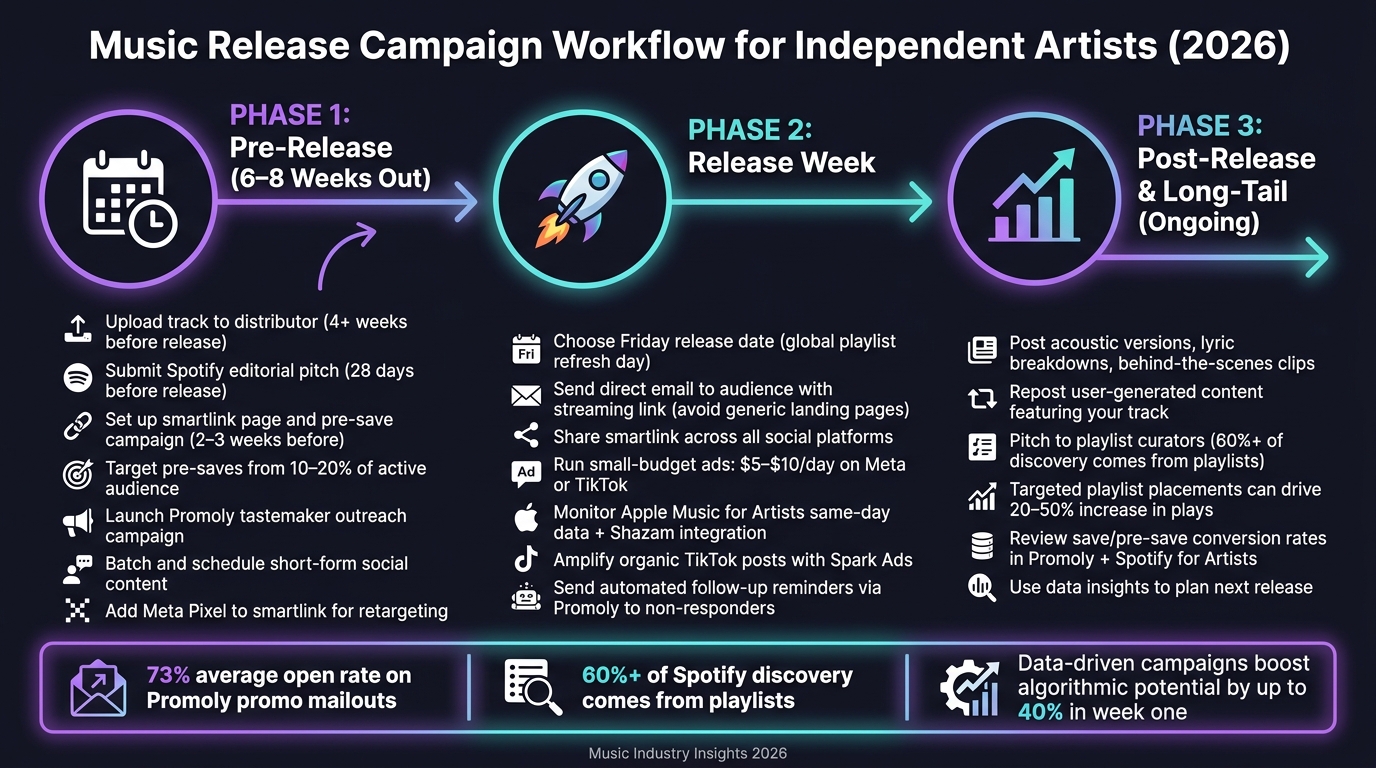
Music Release Campaign Timeline for Independent Artists (2026)
Planning a music release requires a solid 6–8 weeks of preparation for distribution, asset creation, pitching, and promotion. Think of it like a funnel: guiding fans through stages of awareness, intent, action, and finally, retention.
Pre-Release Stage
Start by securing a Friday release date. Why Friday? It’s when global playlists refresh, giving your track the best chance to land on Spotify’s Release Radar. Upload your track to your distributor at least four weeks in advance. This ensures it appears in Spotify for Artists in time for you to submit an editorial pitch. Spotify recommends pitching 28 days before release for the best shot at playlist placement.
While your distribution is underway, focus on setting up your smartlink page and launching a pre-save campaign 2–3 weeks before release. Aim for pre-saves from 10–20% of your active audience, whether that’s your email list subscribers or your monthly listeners. Use tools like Promoly to organize your promo contacts and schedule tastemaker outreach ahead of time. Planning is key – batch your social content in advance, prioritizing short-form videos with your track as the original audio.
Release Week
Release week is all about executing your plan. On launch day, send a direct email to your audience with a link to your preferred streaming platform. Avoid general landing pages – direct links drive stronger streaming signals. Share your smartlink across social media and run small-budget ads ($5–$10/day) on platforms like Meta or TikTok to expand your reach.
Keep a close eye on your analytics. Apple Music for Artists now offers same-day data and Shazam integration, allowing you to track engagement in real time. If a TikTok post starts gaining organic traction, amplify it with a Spark Ad instead of launching a new campaign from scratch.
"A release without data is a shot in the dark. A data-driven campaign turns your release into a calculated launch, boosting algorithmic potential by up to 40% in the first week." – Artist.Tools
This structured approach sets the stage for effective post-release strategies.
Post-Release and Long-Tail Promotion
The buzz on release day is just the beginning. In the weeks that follow, keep your audience engaged with fresh content like acoustic versions, lyric breakdowns, or behind-the-scenes clips. Repost user-generated content from fans using your track. On Spotify, playlists account for over 60% of discovery, and securing targeted placements can drive a 20–50% increase in plays. Use real-time data to guide your outreach to playlist curators now that your track is live and reviewable.
Dive into your analytics on platforms like Promoly and Spotify for Artists. Pay attention to metrics like save and pre-save conversion rates – they’ll offer valuable insights for your next release. Use this data to fine-tune your ongoing campaign and lay the groundwork for future launches.
Conclusion: Choosing the Right Tools for Independent Artists
In 2026, success in music promotion hinges on picking the right tools. With a streamlined approach, most independent artists can manage a professional marketing setup for less than $50 per month. The key? Keep it simple – one tool for each task, and make sure every tool justifies its spot in your lineup.
Once you’ve chosen your core tools, focus on layering their functions effectively. Start with the basics: streaming profiles and smartlinks lay the groundwork. Add Promoly to handle tastemaker outreach and pre-save campaigns. Use social scheduling tools to stay consistent, email marketing to keep your audience engaged, and analytics to refine your efforts.
"The best music marketing tools solve specific problems without creating new ones." – Orphiq
One critical takeaway: understand the difference between owned and rented channels. Social media might give you reach, but it’s unpredictable. Your email list and fan data, on the other hand, are assets you truly control.
Make it a habit to audit your tools every quarter. If a tool isn’t delivering measurable results, cut it. As Orphiq wisely puts it, "Tools support execution but do not replace strategy". By staying lean and focused, you’ll ensure every tool works to push your music career forward.
FAQs
What does “owned momentum” mean for artists?
"Owned momentum" refers to the consistent growth an artist achieves using their own resources. This includes leveraging tools like their fanbase, social media platforms, and email list. The focus is on creating progress independently, rather than relying on external platforms or short-lived viral moments. It’s about building something sustainable that the artist fully controls.
How early should I upload and pitch a release to Spotify?
To increase your chances of getting your track onto a playlist, submit your release to Spotify at least 7 days before the release date. For even better results, try to pitch it 2 to 4 weeks in advance. This gives your submission more time to be reviewed and considered.
Which 3 tools should I start with on a small budget?
Start by using free tools that can help you manage and promote your music more effectively. For instance, Spotify for Artists offers streaming analytics and lets you pitch your tracks to playlists. When it comes to social media, apps like Buffer or Meta Business Suite make scheduling posts a breeze. And for creating a central hub for your links, platforms like Linktree or Carrd are great options. The best part? These tools don’t require any upfront investment, making them perfect for artists just getting started.