Low Engagement on Music Promos? 8 Quick Fixes That Work
If your music promos aren’t connecting, you’re not alone. With over 120,000 new tracks uploaded daily, standing out is tough. Low engagement often stems from poor targeting, weak messaging, bad timing, or disorganized campaigns. But these issues are fixable. Here’s how to boost your music’s visibility and performance:
- Identify the Problem: Analyze key metrics like save rates, skip rates, and open rates to pinpoint weak spots.
- Refine Targeting: Segment your audience and pitch to the right people, like playlist curators or fans of similar artists.
- Improve Messaging: Use engaging subject lines and hooks that focus on the recipient’s interests.
- Optimize Visuals & Landing Pages: High-quality cover art and streamlined landing pages can increase clicks and saves.
- Perfect Timing: Send emails on optimal days (Tuesday–Thursday mornings) and follow up strategically.
- Pitch Smarter: Focus on niche playlists and personalize your outreach.
- Tailor Social Media: Use platforms like TikTok for discovery and Instagram for fan engagement.
- Leverage Data: Track engagement and adjust your strategy based on analytics.
8 Music Marketing Strategies That Actually Work | Ditto Music
sbb-itb-888513b
Identify the Real Engagement Problem First
Before tweaking your campaign, figure out exactly where engagement is falling short. Low engagement isn’t just one issue – it can stem from multiple challenges, each needing a tailored fix. If you treat all problems the same, you risk wasting time and money.
Start by breaking your metrics into two types: leading indicators (which predict future outcomes) and lagging indicators (which reflect past performance). For instance, monthly listeners are a lagging indicator, showing what already happened. On the other hand, your save rate – the number of saves divided by total streams – is a leading indicator. A drop in save rate today often signals a decline in monthly listeners within three weeks.
"Monthly listeners is a lagging indicator – it confirms what already happened. Leading indicators, by contrast, give you signal before the outcome appears. A falling save rate today predicts a monthly listener decline in three weeks." – Chartlex
Here’s a quick guide to core metrics, their benchmarks, and potential red flags:
| Metric | Healthy Benchmark | Red Flag |
|---|---|---|
| Save Rate | 15% or higher | Below 8% – could point to a hook or track issue |
| Follower Conversion | 20% or higher | Below 10% – indicates a profile or catalog problem |
| Stream Velocity | Flat or growing | Declining for three straight weeks |
| Algorithmic Traffic Split | 40%+ from algorithmic sources | Below 30% – too reliant on playlists |
| Intro Skip Rate | Low | High skips within the first 15 seconds |
Streaming metrics are just part of the picture. Email promotions can also highlight engagement issues. For example, if your open rate is under 30%, the problem might lie in your subject line or the quality of your email list – not your music. And if people click but don’t save, you might be targeting the wrong audience.
Platforms like Spotify for Artists give you insights into streams, saves, and audience demographics. During the pre-release phase, tools like Promoly can help you track promo opens, how long tracks are being listened to, and audience feedback. This data shows whether a track is connecting with listeners before you scale up your efforts.
"Sending promos without collecting feedback is like throwing a party and never checking if anyone showed up." – Promoly
The key is not to get overwhelmed by data. Focus on the metrics that are underperforming and take action right away.
1. Tighten Your Promo Targeting and Segmentation
If your metrics are lagging, it’s time to revisit the basics: Who exactly are you trying to reach? Casting too wide a net often leads to poor engagement. With over 120,000 new tracks uploaded daily to streaming platforms, sending promos to the wrong audience not only drains your budget but also hurts your reputation.
"One of the fastest ways to get ignored is sending the right track to the wrong person." – Promoly
Start by segmenting your contact list based on role and genre. A radio programmer, a playlist curator, and a music blogger all have different priorities and workflows. Tailored pitches designed for specific curators have a 28% placement rate, compared to only 4% for generic, copy-paste emails. You can refine this even further by dividing your audience into engaged and less responsive groups. Offer early access or exclusive material to your most loyal fans, while using re-engagement strategies for those who are less active. Tools like Promoly’s campaign dashboard allow you to track who’s opening your promos and for how long, so you can focus your energy on the most interested recipients.
A smart way to begin is by researching five artists similar to you, particularly those with 10,000–50,000 monthly listeners. Look at the playlists they’re featured on, their niche, and where their fans are concentrated. This kind of “sonic neighbor” research helps you zero in on specific playlists, regional influencers, or niche blogs that align with your sound. A targeted, thoughtful approach like this will always outperform a broad, scattershot strategy.
2. Rewrite Your Subject Lines, Titles, and Opening Hooks
Your subject line is your first – and often only – shot to grab attention. Promoly highlights this perfectly: "Music inboxes are overcrowded. Your subject line has about two seconds to convince someone to open." That’s an incredibly tight window, yet many music promo emails still rely on bland lines like "My new single is out now on Spotify", which are easily ignored. If you want to stand out, it’s time to rethink your approach.
The key? Shift the focus from yourself to your audience. Chris Robley from Reverbnation explains:
"The formula is pretty simple: Make it about them, not you; Personalize it when appropriate; Don’t use musician lingo; talk about feelings and stories; Create a sense of urgency or mystery."
This audience-first mindset is essential to boosting engagement. Instead of just announcing your release, craft a subject line that speaks directly to the recipient’s interests. For instance, "Dark electronic, influences: Moderat, Burial" gives a curator exactly what they need to decide quickly. Nadav Peleg reinforces this point:
"Editors don’t need your excitement. They need fit. Name the mood, listener moment, or anything that stands out."
Specificity matters. Personalized pitches can achieve placement rates of around 28%, compared to just 4% for generic ones. That’s a huge difference, and it all starts with being deliberate in your messaging.
Once your subject line grabs their attention, your opening hook has to seal the deal. Start with a single sentence that explains why your track is relevant to them right now. Reference something specific, like a playlist they curate or an article they’ve written recently. This kind of personalization does far more than a long-winded email full of generic hype. Also, steer clear of rookie mistakes like using all caps, spammy words like "free" or "click here", and BCCing multiple contacts – it screams mass email and kills credibility.
Here’s a formula that works: Genre + Context + Hook. For example, a subject line like "Indie folk single, recorded in a cabin during a wildfire season" immediately creates intrigue and offers context. Combine this with A/B testing across different recipient groups to figure out what resonates best.
3. Improve Your Promo Assets and Landing Page Experience
Even the perfect subject line won’t save a campaign if the experience that follows feels clunky or unprofessional. Your visual assets and landing page are where initial interest either turns into action – or fades away. And it all starts with your cover art.
Cover art is the first thing listeners and curators notice. A clean, focused image with high contrast and minimal text performs better. In fact, cover art with these qualities sees a 19% higher click-through rate in playlist contexts when compared to designs that are cluttered or low-contrast. To ensure your cover art meets platform standards, stick to these specs: 3,000×3,000px, RGB color mode, JPG or PNG format.
But visuals are just one piece of the puzzle. Many promotional efforts falter at the landing page. Sending users directly to a Spotify URL can be a missed opportunity. Without tracking tools like a Meta or TikTok pixel, you’re left with clicks but no real data on conversions. A dedicated landing page with tracking capabilities solves this problem while also making the user journey smoother. As AllAboutMusicBusiness says:
"The fewer clicks between curiosity and playback, the better."
For industry-specific promos, your landing page should offer both a private streaming link and a downloadable file. DJs, A&Rs, and music supervisors often have different needs. Providing both options ensures you’re not losing engagement simply because of a format mismatch.
Finally, consider adding dynamic elements like Spotify Canvas to your strategy. This looping 3–8 second vertical video can increase listener engagement by an average of 5%, and tracks with Canvas are 4x more likely to be shared on social media. It’s a simple way to show curators and listeners that you’re serious about your release while also boosting visibility.
4. Make Email Promos Shorter and Easier to Scan
When it comes to email promos, brevity and clarity are your best friends. Industry professionals sift through hundreds of emails daily, so if yours doesn’t quickly convey who you are and why you’re reaching out, it’s likely to get skipped.
"If your email appears laborious to scan, it won’t be read." – All About Music Business
The solution? Keep it under 150 words. That’s just enough space to introduce yourself, include a listening link, and make a single, clear request. Stick to a simple three-part structure: a short intro, a prominent streaming link, and a direct call to action like "Let me know if you’d like a download link". This approach works hand-in-hand with targeted messaging to maximize impact.
Formatting plays a big role in making your email easy to digest. Highlight your call to action (CTA) so it stands out immediately. Use bullet points sparingly for key details – artist name, track title, genre, and release date – allowing readers to grab the essentials at a glance. Make sure your streaming link is easy to find and tap, especially for mobile users, as many curators review emails on their phones. Adding white space can also make your email feel less cluttered and more inviting.
Promoly sums it up perfectly:
"Be brief, confident, and let your music shine."
| Element | Recommendation |
|---|---|
| Total Word Count | Under 150 words |
| Subject Line Length | 30–50 characters |
| Visuals | 1 high-quality image |
| CTA | Single, bold, and clear |
| Links | Embedded player or clean streaming link |
These adjustments can make your emails more effective, ensuring they grab attention and deliver your message without wasting time.
5. Fix the Timing and Frequency of Your Campaigns
Timing can make or break a promo campaign. It’s not just about when your email lands in someone’s inbox but also about how often they hear from you. Let’s dive into how to get the timing and frequency just right to make your promotions more effective.
The best days to send music promo emails? Tuesday through Thursday mornings. That’s when industry contacts like curators, DJs, and journalists are actively sifting through their inboxes. As Promoly explains:
"Send emails Tuesday through Thursday in the morning when contacts are actively working through their inbox."
Avoid weekends and late nights – those are low-activity times when open rates tend to drop. Fridays, especially major release days, can also be tough since inboxes get flooded with competing releases.
Lead time is another critical factor. Different recipients need varying amounts of notice to plan effectively. Here’s a breakdown of recommended lead times for key contacts:
| Target Recipient | Recommended Lead Time | Purpose |
|---|---|---|
| Radio Programmers | 4–6 weeks before release | Format planning and scheduling |
| Spotify Editorial | 3–4 weeks before release | Editorial review and placement |
| Playlist Curators / Press | 2–3 weeks before release | Review and inclusion in launch-day lists |
| Core Fan Email List | Release Day | Driving immediate stream velocity |
When it comes to how often you should email, less is more during a release cycle. Stick to three emails:
- A main announcement on release day.
- A follow-up on Day 3 or 4 with fresh content like behind-the-scenes clips or lyric highlights.
- A third email only if you have new, noteworthy material to share.
In between releases, aim to send two updates per month to keep your audience engaged without overwhelming them.
For tastemakers like curators or journalists, follow up politely 3–4 days after your initial email. Usually, one follow-up is enough – any more, and you risk coming across as overly persistent.
6. Sharpen Your Playlist and Tastemaker Pitching
Once you’ve refined your targeting and messaging, it’s time to focus on your playlist and tastemaker strategy to boost your track’s algorithmic momentum. The key to success here isn’t about landing a single massive playlist. Instead, aim for placements on multiple relevant playlists at the same time. Why? Tracks featured on three or more targeted playlists simultaneously are 4.2 times more likely to show up on algorithmic playlists like Discover Weekly. It’s all about building enough engagement to let the algorithm do the heavy lifting.
Focus Your Pitch for Maximum Impact
Broad, generic pitching can dilute your efforts. Instead of targeting broad categories like "indie rock", get specific. Think about mood or setting – terms like "late night drive" or "Sunday morning focus" can lead you to playlists with more engaged audiences. These smaller, niche playlists often have more active listeners. For example, playlists with 500–5,000 followers typically see an average save rate of 4.8%, compared to just 2.1% on larger editorial lists.
Vet Playlists Before Pitching
Before sending your pitch, take a closer look at the playlists you’re targeting. Check if they’ve been updated in the last 2–4 weeks, as stale playlists are less likely to drive meaningful engagement. Also, be cautious of inflated numbers. A playlist with 50,000 followers but only 200 monthly listeners likely relies on bots. Spotify’s crackdown on artificial streaming activity led to the removal of over 10,000 playlists in 2025.
Personalize Your Pitch
When pitching, keep it short and to the point – 100 to 150 words is ideal. Personalization is crucial. Mention a specific track already on the playlist and explain how your song complements it in terms of mood or BPM. Skip lengthy bios and focus on how your track fits the playlist’s vibe. Always include a direct Spotify link instead of attachments, and craft subject lines that include the playlist name – this simple tweak can boost your email’s open rate by 27%.
Timing and Follow-Ups
Timing matters. Reach out to independent curators 7–14 days before your release. If you don’t hear back, send a follow-up email 5–7 days later. Avoid excessive follow-ups, as they can hurt your chances and might even get you blocked.
These targeted adjustments, combined with earlier improvements to your email strategy, can help you build a cohesive and effective promotional plan.
7. Tailor Social Media Promos to Each Platform
Social media isn’t one-size-fits-all, especially when it comes to music promotion. Each platform has its own strengths and quirks, and understanding how to use them can make a world of difference. For instance, TikTok has become a powerful discovery tool for reaching new listeners, while Instagram excels at converting casual fans into loyal followers. Knowing this distinction can help you refine your content strategy.
Here’s what the numbers tell us: nearly half (47%) of listeners find new songs on short-form video platforms like TikTok before they even hear them on Spotify. Plus, a staggering 84% of the songs that made it onto the Billboard Global 200 in 2024 first gained traction on TikTok. These stats highlight the importance of a well-thought-out content plan.
"A viral video that reaches 2 million people who do not care about your music is worth less than a video that reaches 5,000 people who save the song." – Orphiq
To help you navigate, here’s a breakdown of how to approach each platform in your music promo campaign:
| Platform | Primary Role | Posting Cadence | Best Content Type |
|---|---|---|---|
| TikTok | Discovery | 4–7x per week | Behind-the-scenes clips, song snippets, trending challenges |
| Conversion | 3–5 Reels + daily Stories | High-energy Reels, personal Stories | |
| Community & Events | 1x per day (release week) | Storytelling, giveaways, local show updates | |
| YouTube | Evergreen Catalog | 2–4 Shorts + 1–2 long-form/mo | Music videos, acoustic sessions |
Key Tips for Each Platform
- Instagram Reels perform best when they’re 7–15 seconds long, with over 80% of viewers watching with the sound on.
- On TikTok, the algorithm prioritizes watch-through rates and replays over likes or follower counts. This means your content needs an attention-grabbing hook in the first 1–2 seconds.
- Avoid posting TikTok videos with watermarks directly to Instagram Reels – Instagram’s algorithm suppresses these posts.
To keep your content consistent and manageable, consider batching your efforts. Dedicate 2–4 hours each week to filming and editing 5–8 short-form videos. A single studio session can yield content tailored for TikTok, Instagram Reels, and YouTube Shorts. Artists who post short-form videos at least three times a week see 2.5× more visits to their Spotify profiles from external sources.
8. Use Feedback and Analytics to Adjust Campaigns Fast
Making quick adjustments based on data can transform your promotional efforts. Engagement challenges often surface only after a campaign goes live, so keeping a close eye on your metrics and acting promptly is crucial. Here’s what to focus on for meaningful insights.
While total streams and follower counts might seem impressive, it’s the high-intent metrics like save rates, listen-through rates, and playlist adds that reveal how well your audience is connecting with your content. For instance, if a track has strong streaming numbers but a low save rate, it suggests listeners are only passively hearing it – maybe on a playlist they don’t find engaging. This usually points to a targeting issue rather than a problem with the track itself. Similarly, low open rates or click-through rates (CTR) in email campaigns can highlight issues with either your targeting or the content.
One critical behavior to monitor is the skip rate. Data shows that tracks with intros longer than 15 seconds tend to have a 23% higher skip rate on average. If your analytics reveal listeners dropping off before the 30-second mark, it’s a signal that your hook isn’t grabbing attention quickly enough. In this case, shortening the intro and testing again can make a big difference.
Set aside just 30 minutes each month to analyze which content formats are driving saves and shares, and cut out those that consistently underperform. If you notice repeated listens without engagement, consider following up thoughtfully using this data to guide your approach. Small, steady tweaks often outperform infrequent, large-scale changes.
Tool Comparison Table
Music Promo Platform Comparison: Best Tools for Every Stage
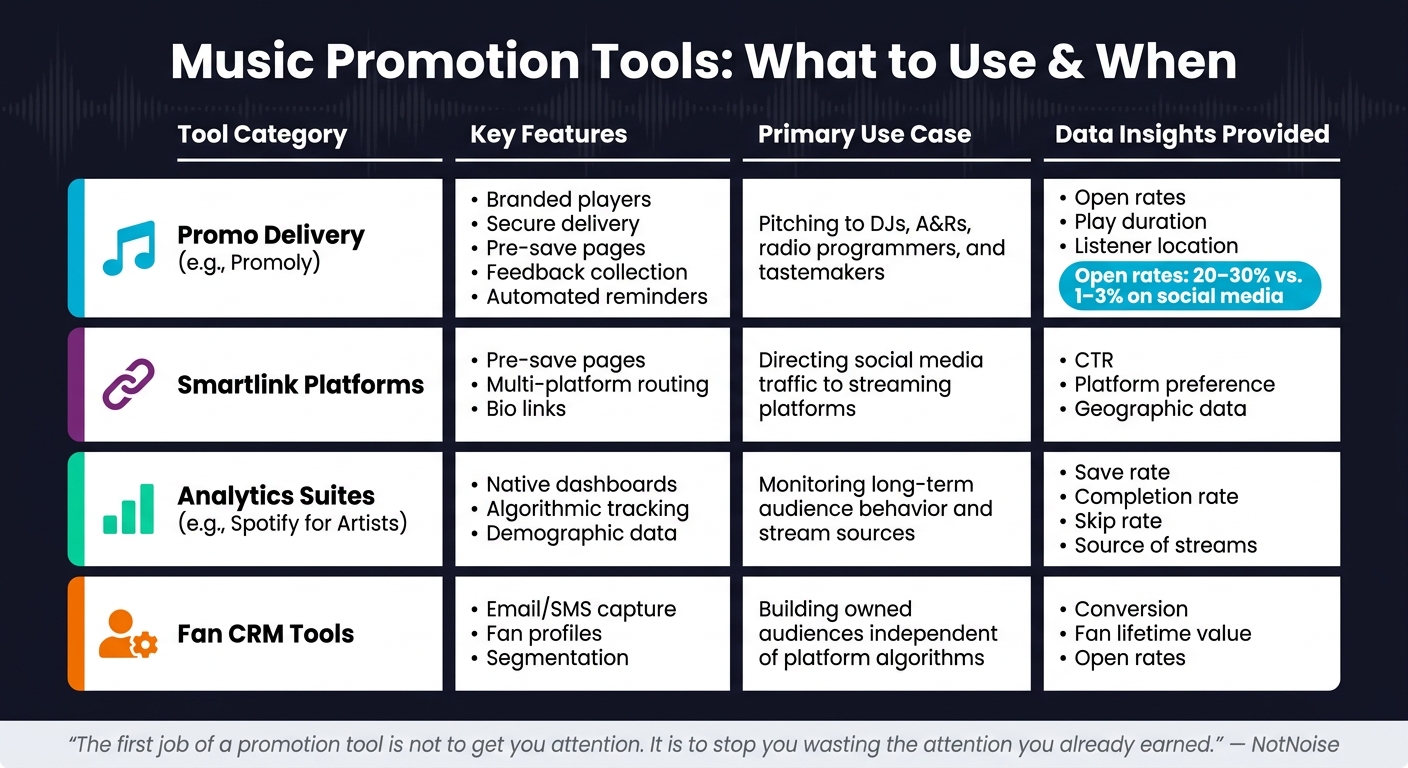
Choosing the right tools to tackle engagement challenges is just as important as refining your promotional strategies. Whether you’re focused on pitching, optimizing landing pages, or analyzing post-release performance, the right tool can make all the difference. Here’s a breakdown of key tool categories and what they bring to the table:
| Tool Category | Key Features | Primary Use Case | Data Insights Provided |
|---|---|---|---|
| Promo Delivery (e.g., Promoly) | Branded players, secure delivery, pre-save pages, feedback, automated reminders | Pitching to DJs, A&Rs, radio programmers, and tastemakers | Open rates, play duration, listener location |
| Smartlink Platforms | Pre-save pages, multi-platform routing, bio links | Directing social media traffic to streaming platforms | Click-through rate (CTR), platform preference, geographic data |
| Analytics Suites (e.g., Spotify for Artists, Apple Music for Artists) | Native dashboards, algorithmic tracking, demographic data | Monitoring long-term audience behavior and stream sources | Save rate, completion rate, skip rate, source of streams |
| Fan CRM Tools | Email/SMS capture, fan profiles, segmentation | Building owned audiences independent of platform algorithms | Conversion, fan lifetime value, and open rates |
Each tool plays a unique role in boosting engagement when paired with well-timed messaging and targeting strategies.
For instance, promo delivery platforms like Promoly offer detailed insights such as open rates and play duration, helping you refine your pitch for DJs, tastemakers, and other key contacts. On the other hand, analytics suites like Spotify for Artists provide a broader view of how your music performs across your listener base, tracking metrics like save rates and stream sources. Together, tools like these give you a full picture of your promotional efforts.
"The first job of a promotion tool is not to get you attention. It is to stop you wasting the attention you already earned." – NotNoise
One standout statistic? Email promo tools achieve open rates of 20–30%, compared to just 1–3% on social media. That’s a compelling reason to keep a promo delivery tool in your arsenal, especially for pre-release outreach to industry contacts.
If you’re curious about Promoly, their free trial lets you send up to 150 emails over seven days – no credit card needed. It’s a low-risk way to test the waters and gather real engagement data before committing to a paid plan.
Conclusion
Low engagement is often a sign that your promotional strategy needs a fresh approach. The eight fixes discussed here tackle various weak points in the process, from refining your audience targeting and crafting better subject lines to upgrading your promo materials, perfecting your timing, improving your pitches, and making data-driven decisions.
The good news? These adjustments don’t require a massive budget – just consistency. In a landscape where over 120,000 new tracks are released daily and most artists struggle to surpass 1,000 streams per release, success comes from running smart, intentional campaigns.
The key is to treat promotion as a repeatable system. Small improvements add up: better subject lines can lead to higher open rates, which drive more listens and nudge streaming algorithms in your favor. Each tweak – whether it’s better email targeting or an optimized landing page – contributes to a stronger promotional framework. Letting your metrics guide you ensures steady progress over time.
"Sustainable promotion is less about one viral moment and more about building predictable systems for exposure, engagement, and monetization that amplify each new release over time." – Jamal Farouk, Motivi Loves Music
Start small: pick one or two fixes, track the results, and refine your approach. Independent artists who maintain a clear, measurable marketing strategy are 3.5 times more likely to achieve their streaming goals. It all begins with understanding what to monitor and why.
FAQs
Which one metric should I fix first?
Streaming platforms like Spotify rely heavily on engagement metrics to determine which tracks deserve more visibility. Among these metrics, your save rate – the percentage of listeners who save your song to their library or playlist – is a key indicator of how well your music connects with audiences.
A high save rate tells the algorithm, "This song is worth sharing." This boosts your chances of landing on editorial playlists and being included in algorithmic recommendations like Discover Weekly or Release Radar.
Here’s the thing: before you dive into scaling paid promotions, make sure your music is already driving genuine engagement. Focus on creating tracks that encourage listeners to save, listen all the way through, and even follow your artist profile. These organic signals are what fuel long-term algorithmic support and help your music reach a wider audience.
How do I know if my list targeting is wrong?
If you’re sending your music to people who don’t work with your genre or subgenre, your list targeting might need some fine-tuning. Common signs include high silence rates or pitches being ignored – especially if your outreach feels generic or mismatched. Instead of relying on broad, non-specific lists, focus on curators who are a good fit for your style. Double-check that your metadata accurately describes your music, and research artists with a similar sound to ensure you’re reaching out to the right people.
What’s the fastest change to boost saves?
The fastest way to boost saves is by hosting listening parties. These events often result in 2–3x higher first-day save rates compared to typical release announcements. Another effective strategy? Simply ask your fans. Use social media posts or emails to encourage them to save your music, and explain how saves help algorithms recommend your track to more listeners.
You can also use video clips on Spotify Countdown Pages to grab attention. This approach has been shown to double pre-saves, creating early momentum that fuels algorithmic growth.