Smartlinks vs Traditional Links: Which Converts Better?
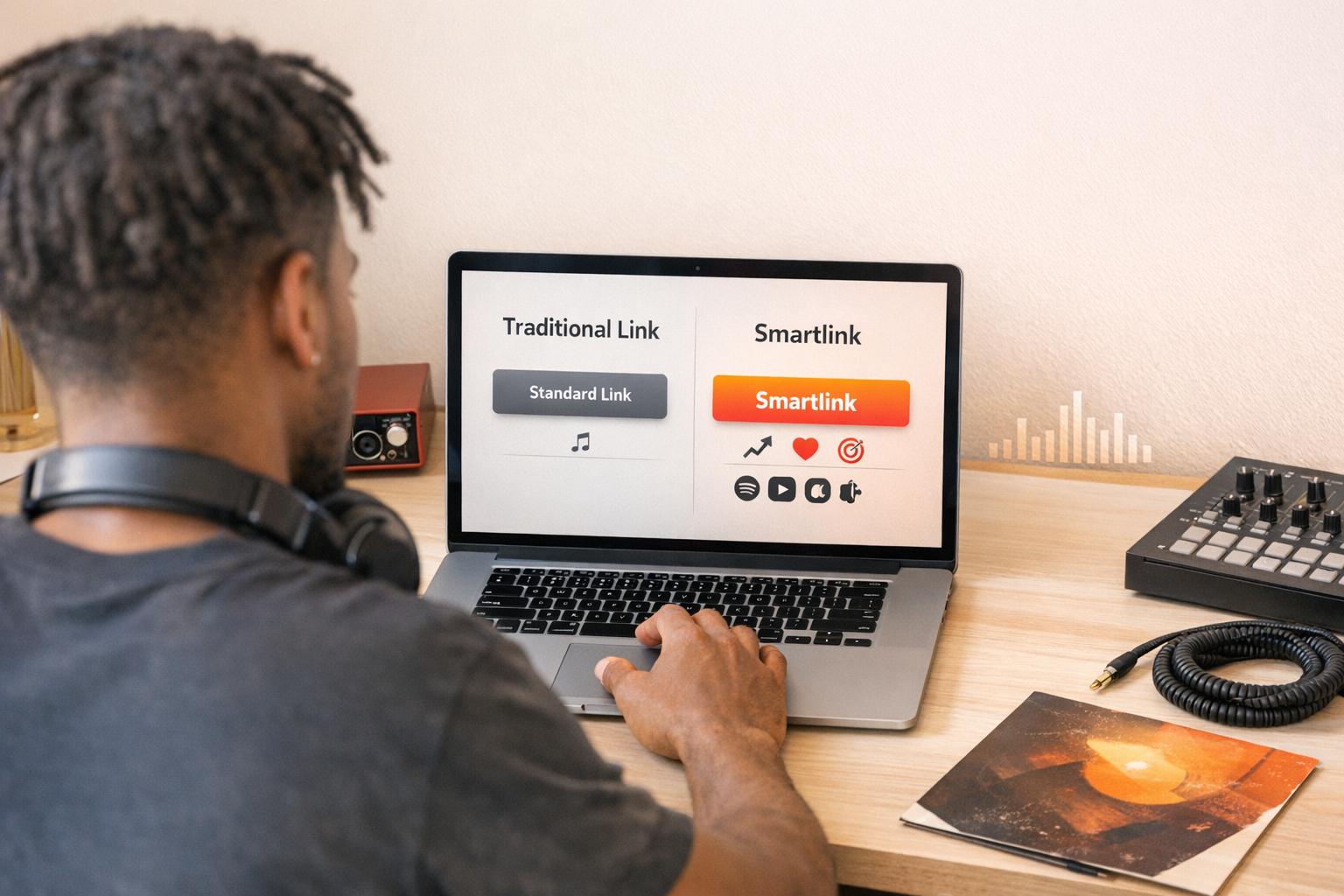
Smartlinks consistently outperform traditional links for music promotion. Why? They cater to diverse audiences by allowing fans to choose their preferred platform, reducing drop-offs. Traditional links, while simple and fast, only direct to one platform, alienating users who prefer alternatives like Apple Music or YouTube.
Key Takeaways:
- Smartlinks: Offer platform options, track analytics, support pre-saves, and enable retargeting. Ideal for campaigns targeting broad audiences.
- Traditional Links: Direct to a single platform, work for niche audiences or straightforward needs but lack flexibility and tracking.
Quick Comparison:
| Feature | Smartlinks | Traditional Links |
|---|---|---|
| Routing | Multi-platform options | Single destination only |
| Analytics | Tracks clicks, sources, etc. | Basic click count only |
| Pre-save Support | Yes | No |
| Retargeting | Yes (e.g., Facebook Pixel) | No |
| Setup Time | ~5 minutes | Instant copy/paste |
For campaigns aiming to maximize reach and engagement, smartlinks often deliver a 35–50% boost in streams compared to traditional links. Choose based on your goals and audience needs.
Smart Links For Music: Which Is Best For Growing Streams?
sbb-itb-888513b
What Are Smartlinks?
A smartlink is a single, shareable URL that leads to a landing page where listeners can pick their favorite streaming service. Instead of tying fans to just one platform, it brings together access to all the big names – like Apple Music, YouTube Music, and Amazon Music – in one place. Smartlinks rely on your track’s ISRC code to locate and match your music across platforms. They also provide targeted analytics and routing options. When a fan clicks a smartlink, it either shows them a selection of platforms or automatically redirects them based on their device. Let’s dive into what makes smartlinks stand out.
Key Features of Smartlinks
Smartlinks go beyond simple routing, offering tools designed to boost engagement and streamline the listener experience.
Dynamic routing is one standout feature. It identifies a listener’s device and preferred app, then directs them to the right place. This reduces the chances of losing fans mid-click and increases the likelihood they’ll finish streaming your track. By eliminating unnecessary steps, dynamic routing helps convert interest into action.
Geo-targeting is another handy feature. It displays region-specific content, like local tour dates or country-specific storefronts, based on where the listener is located. This makes your promotions feel more relevant and personalized.
For unreleased tracks, pre-save functionality is a game-changer. It allows fans to save a track to their library before it’s even out, ensuring it’s ready for them on release day. At the same time, this feature can collect fan emails, helping you build a direct connection with your audience.
Additionally, retargeting pixel support lets you embed Meta, TikTok, or Google pixels into the landing page. This enables you to re-engage anyone who clicked the link through paid ads, extending the life of your campaigns.
Benefits of Using Smartlinks
Smartlinks are designed to keep listeners engaged by sending them directly to their preferred platform. With over 80% of smartlink clicks coming from mobile devices, ensuring a seamless transition to apps is essential for minimizing drop-offs.
"A smart link is not just a convenience page. It is the handoff point between attention and listening." – Florencia Flores
For labels, smartlinks provide an analytics layer that tracks clicks, geographic data, and platform preferences across a catalog of releases. For publicists, branded smartlinks in press releases look more polished than raw URLs and offer a clean, platform-neutral way for media to access your content. For independent artists, tools like Promoly combine smartlinks with pre-save campaigns and email collection, making it easier to grow your fanbase while promoting your music.
A click-through rate (CTR) above 60% shows strong performance, while anything below 40% suggests your landing page could use some fine-tuning.
What Are Traditional Links?
A traditional link is a simple, static URL that takes users to a single destination – no landing pages, no routing options, and no flexibility for the audience. Unlike smartlinks, these links don’t cater to varying streaming preferences, which makes them less effective for reaching audiences across multiple platforms. On the plus side, they’re free to create, require no setup, and work immediately.
"A raw Spotify link tells the audience nothing about their viewing options." – SongPort
When Traditional Links Work Well
Traditional links can be useful in specific situations. For example, they work perfectly fine when you’re sharing a track with an audience that you know uses a particular platform. They’re also great for non-music destinations – like directing fans to a merch store, a page for tour dates, or a newsletter sign-up – where only one destination is relevant.
But when it comes to connecting with a broader, cross-platform audience, these benefits are quickly outweighed by their shortcomings.
Limitations of Traditional Links
The biggest issue with traditional links? Lost audience members. By relying on just one platform, you risk alienating around 40% of your potential listeners. Fans who prefer a different service are left to search for your music manually – and most simply won’t bother.
Traditional links also lack key features for today’s marketing needs. They don’t provide cross-platform analytics, so you can’t track whether clicks came from Instagram, TikTok, or an email campaign. They don’t support retargeting pixels or pre-save campaigns either. And if your track gets re-released or the URL changes, the link can break entirely, leaving you to fix it manually.
"If you post an Apple Music link and 60% of your followers use Spotify, you’ve just made it harder for the majority of your audience to hear your music. They have to manually search for the song, and most won’t bother." – PromoLinks
Factors That Drive Conversions in Music Promotion
Getting someone to click a link is just the beginning. The real challenge lies in turning that initial interest into streams. What makes some campaigns succeed while others struggle? It often comes down to three key elements.
Friction and User Experience
Every extra step between a fan and your music increases the chance they’ll drop off. If a listener lands on a page and has to figure out what to do next, you’ve already lost some momentum. And since over 80% of link clicks from social platforms come from mobile devices, a clunky or slow-loading page can seriously hurt your chances of converting those clicks into streams.
Smartlinks help by automatically directing users based on their device, minimizing unnecessary steps and keeping the process smooth. In some cases, though, offering fans a choice page can work better, giving them control over their experience.
"The best smart link is not the prettiest one. It is the one that wastes the fewest clicks." – Florencia Flores
Traditional links, on the other hand, funnel all traffic to a single platform. If that platform isn’t what a listener prefers, you’ve just created an unnecessary hurdle.
Tracking and Analytics
A simple click count doesn’t tell the full story. Analytics give you a deeper look into what’s working and what’s not. For example, smartlinks create unique URLs for different channels, making it easy to see which sources are bringing in engaged listeners and where fans might be dropping off.
Platforms like Promoly take it a step further by integrating tools like Facebook Pixel directly into campaigns. This way, every click feeds into your retargeting efforts, helping you fine-tune future ads.
"Clicks tell you nothing about the journey. And the journey is where careers are shaped." – MusicBizQR
In contrast, traditional links usually just provide a basic click count, leaving you in the dark about traffic sources or audience behavior.
Audience Segmentation and Personalization
A one-size-fits-all link won’t cut it when fans have different preferences. Smartlinks allow for audience segmentation by incorporating retargeting pixels from platforms like Meta, TikTok, and Google. This lets you build custom ad audiences, ensuring future campaigns reach fans who’ve already shown interest.
Adding email capture to pre-save pages is another way smartlinks go beyond the basics. It turns a single click into an ongoing connection, giving you a direct line to your audience and opening the door to long-term engagement.
Artists who switch from standard links to smartlinks often see a 35–50% boost in total streams per release. These tools don’t just streamline the fan journey – they make it more effective, setting the stage for a closer look at how different link strategies impact music campaigns.
Smartlinks vs Traditional Links: A Direct Comparison
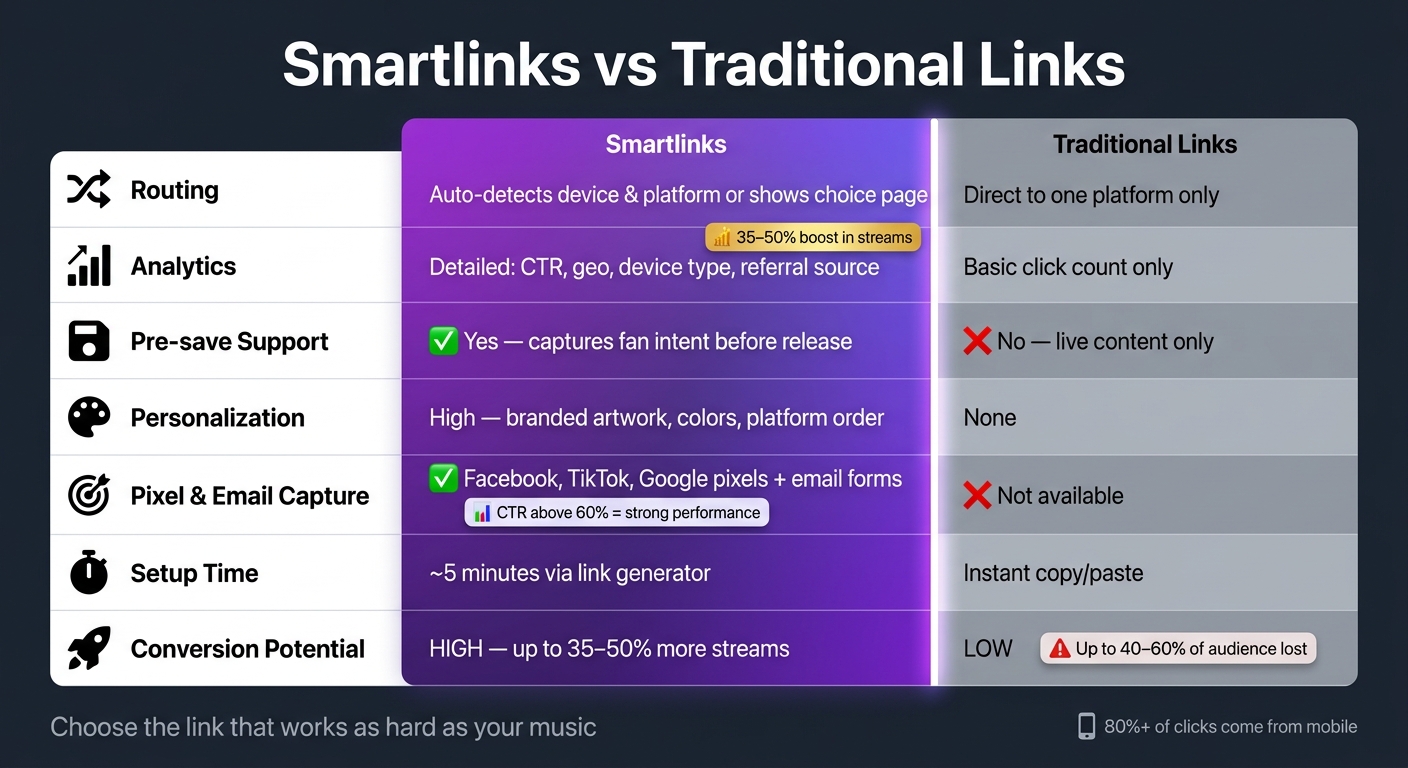
Smartlinks vs Traditional Links: Feature Comparison for Music Promotion
When it comes to driving conversions, smartlinks and traditional links take very different approaches. Think of traditional links as a one-way street – they lead users to a single destination. Smartlinks, on the other hand, act more like a guided tour, offering flexibility and personalization along the way.
Comparison Table
| Feature | Smartlinks | Traditional Links |
|---|---|---|
| Routing | Auto-detects device/platform or offers a choice page | Direct to one platform only |
| Analytics | Detailed – CTR, geo, device type, referral source | Basic click count at best |
| Pre-save Support | Yes – captures fan intent before release day | No – only works for live content |
| Personalization | High – branded artwork, custom colors, platform order | None |
| Pixel & Email Capture | Yes – Facebook, TikTok, Google pixels + email forms | Not available |
| Setup Time | ~5 minutes via a link generator | Instant copy/paste |
| Conversion Potential | High | Low |
This table lays out the key differences in how these link types perform, particularly in terms of audience engagement and conversion rates.
Strengths and Weaknesses of Each Approach
Smartlinks excel when you’re targeting a diverse audience across multiple platforms. For example, a Spotify-only link could cost you up to 30% of first-day streams from fans who prefer other platforms. Smartlinks eliminate that risk by offering users options tailored to their preferences.
"A smart link is a guided journey. Not a menu. Not a container. Not a place to list everything. A movement." – MusicBizQR
The real magic of smartlinks lies in their ability to boost conversions. Tools like Promoly integrate features such as Facebook Pixel, which transforms clicks into retargeting opportunities, helping turn casual visitors into loyal fans. However, they do require some initial setup, and if the landing page isn’t optimized, it can hurt performance. A click-through rate (CTR) below 40% signals a problem, while anything above 60% is considered strong.
Traditional links, on the other hand, are quick and easy to use. They’re perfect for scenarios like internal communications, press kits, or campaigns targeting a single platform. But their simplicity comes at a cost – they lack the analytics, personalization, and retargeting capabilities that make smartlinks so effective for broader campaigns.
In short, traditional links are great for straightforward needs, while smartlinks offer more power and flexibility for campaigns aiming to maximize reach and long-term engagement. Both have their place, depending on your goals.
Which Link Type Converts Better for Music Campaigns?
The answer depends on what you’re trying to achieve. However, for most modern music campaigns, smartlinks tend to outperform traditional links by a wide margin.
When to Use Smartlinks
Smartlinks are your go-to when you’re targeting a broad, multi-platform audience. The streaming world is highly fragmented, with fans spread across platforms like Spotify, Apple Music, YouTube Music, Tidal, and others. Sharing a link to just one platform risks alienating up to 60% of your audience. Smartlinks simplify this by offering a single landing page that caters to everyone, reducing friction and boosting conversions.
Beyond convenience, smartlinks also provide powerful tools like precise channel tracking. This makes them essential for paid ads and analyzing performance across different channels. Platforms such as Promoly streamline this process, offering features like pre-save campaigns, Facebook Pixel integration, and real-time analytics – all in one place.
"Fans don’t convert because of features. Fans convert because of how they feel when they land." – MusicBizQR
Here’s a tip: Since over 80% of social media clicks come from mobile devices, always test your smartlink landing page on a phone before launching your campaign. A seamless mobile experience can make or break your results.
That said, traditional links still have their place, depending on the situation.
When Traditional Links Are Enough
For campaigns where you’re directing traffic to a single destination – like sharing a press kit with a journalist or targeting an audience that primarily uses one platform – traditional links can still work well. In cases where tracking and multi-platform reach aren’t priorities, their simplicity can be an advantage. They’re particularly useful for low-budget campaigns or when the goal is straightforward and doesn’t require advanced analytics.
Final Recommendations
Ultimately, your choice between smartlinks and traditional links depends on the scope of your campaign and your need for data. If you’re a label or publicist managing multi-platform campaigns, smartlinks are essential – they provide the infrastructure for tracking, retargeting, and optimizing your efforts. On the other hand, for single-destination campaigns, traditional links can be perfectly adequate.
A key indicator that it’s time to switch to smartlinks? If you’re investing in ads or growing your fanbase, the tracking and retargeting capabilities of smartlinks deliver measurable results. Artists who transition from platform-specific links to smartlinks typically see a 35–50% increase in total streams per release. That’s a boost you can’t afford to ignore.
FAQs
Do smartlinks slow down clicks?
Smartlinks are built to improve the user experience, not hinder it. These tools function as quick-loading landing pages, efficiently guiding fans to their favorite streaming platforms. By leveraging advanced technology, modern smartlinks ensure pages load in just milliseconds, boosting click-through rates. Features such as mobile-friendly design and instant redirects reduce delays, creating a smooth and efficient journey for users.
What should I track to prove conversions?
To measure conversions effectively, focus on tracking metrics that provide clear insights. For instance, click-through rates (CTR) are a great indicator of engagement – rates above 60% often signal strong interest. Keep an eye on audience geography to uncover regional trends and preferences.
Leverage UTM parameters to pinpoint which traffic sources are driving the most results. If you’re using platforms like Spotify, tracking conversions to streams or sales can offer valuable performance data. Additionally, capturing email signups and implementing retargeting pixels can help you assess deeper audience interactions that go beyond just clicks.
Can smartlinks capture emails legally?
Yes, smartlinks can collect emails legally, but only when users give explicit consent. This often happens through features like pre-save campaigns or email signup forms, where users voluntarily opt in. It’s crucial to always follow relevant data protection laws, like the GDPR or CAN-SPAM Act, to ensure compliance when gathering email addresses.